The APARA Engine
APARA is a compute engine designed to sit next to a SPARC processor as an accelerator. It is built for vector work on small integers and low-precision floats (dot products, reductions, element-wise arithmetic on 4- to 64-bit elements), the kind of computation that is slow on a general-purpose core but very regular. The SPARC processor loads the engine's programs, starts its threads, and moves data in and out of it, while the engine does the number crunching.
The engine was designed at IIT Bombay (Prof. Madhav Desai). This project models it in the same two ways as the SPARC core: a fast functional model, and a Sitar timing model of its pipeline.
The engine at a glance
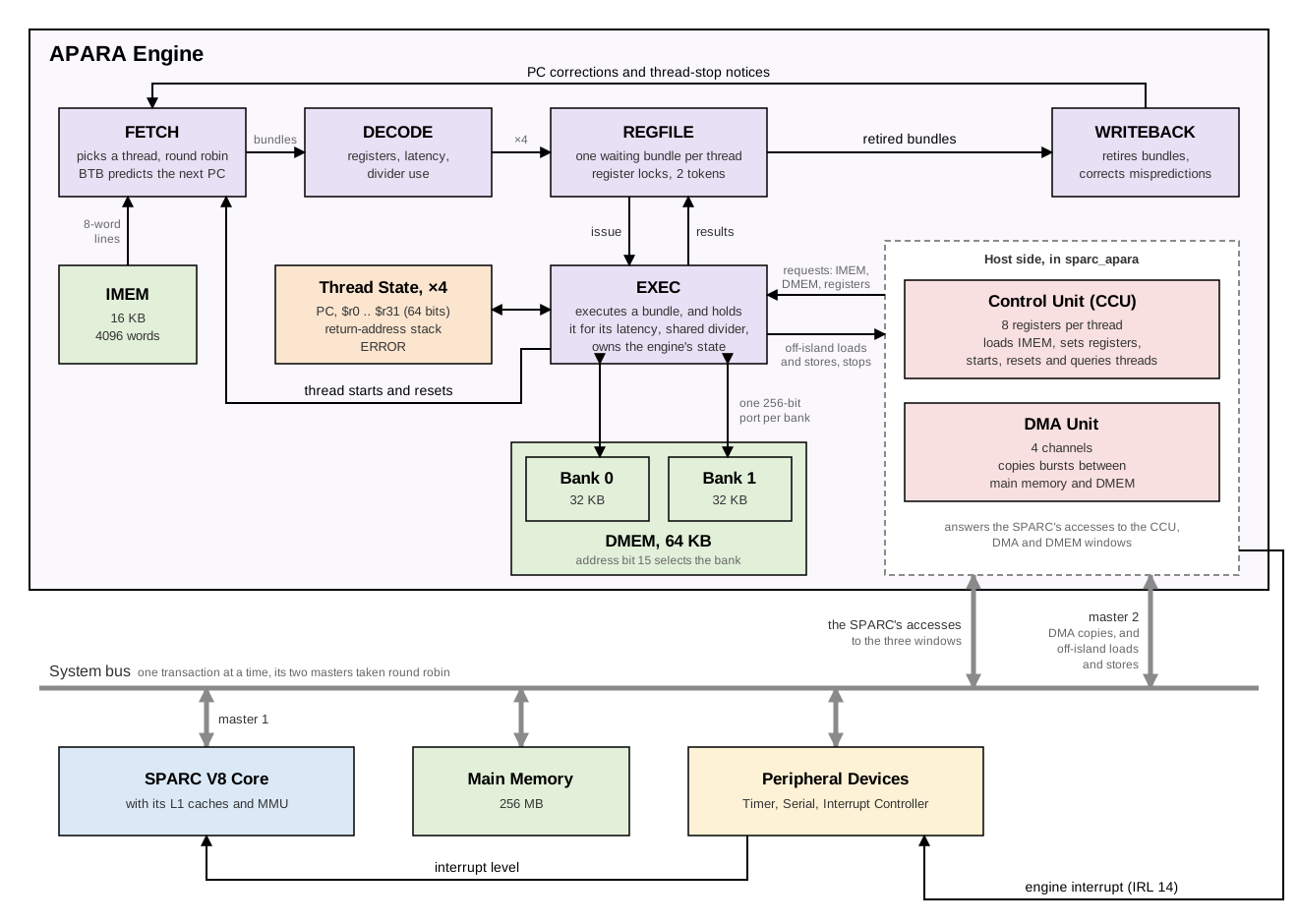
The block diagram below shows the engine's memories, its pipeline and
thread state, and its host side, which connects it to a SPARC system.
The host side, with its control unit and DMA unit, is present only in
the sparc_apara configuration.
- Bundles
The engine is a VLIW machine. Instead of one instruction at a time, it executes bundles of up to 8 instructions, which the program has grouped to run together. - Four hardware threads
Each thread has its own 32 64-bit registers and its own PC, and the four share one five-stage pipeline. When one thread waits, for a result or a branch, the others keep the pipeline busy. - A type in every instruction
A register is just 64 bits. Each instruction says how to read it: as one 64-bit integer, as 8$i8elements, as 16$f4floats, and so on. One vector instruction thus does up to 16 operations. - Local memories
16 KB of instruction memory (IMEM) and 64 KB of data memory (DMEM), in two banks, close to the pipeline and fast. In a system, the engine reaches main memory too, more slowly, and its DMA unit copies data in and out.
In this project
Two configurations model the engine:
apara
One engine on its own. A program and its data are placed in the engine's memories before the run. This is the place to write and test engine programs, and to study the engine's timing.sparc_apara
A SPARC core (with L1 caches, MMU, and peripheral devices) and one engine. The SPARC program loads and runs the engine's programs, and both the engine's DMA unit and its own loads and stores reach the system's memory.
Both come with functional and timing models, tests, and tools.
Where to start
- To write and run engine programs, read the Instruction Set, then Assembly Language and Tools, then Writing and Running Programs.
- To write engine programs in C, such as linear algebra kernels, read The C Compiler.
- To use the engine from a SPARC program, read The Engine in a System for the hardware, then Programming the System, which walks through an example and builds a new program step by step.
- To run the engine's tests, or add one, read APARA Validation Suite.
- To study or change the engine's timing, read the Timing Model.
- For the model's sources, where it deliberately departs from them, and the open questions (mainly for the model's authors), see Deviations and Findings.
The code
| Where | What |
|---|---|
model/cpp_common_code/apara/ |
The engine in plain C++, shared by both models: its state and execution (AparaCore), instruction decoding and arithmetic, the file formats and command line, and, for sparc_apara, the control unit, the DMA unit, and the three joined together for the cpp_model. Also the timing model's latency table and pipeline helpers (AparaTiming.h). |
model/sitar_component_models/Apara*.sitar |
The timing model: AparaEngine and its five stage modules, and AparaHost, the engine's host side in sparc_apara. |
model/sitar_component_models/SystemInterconnect.sitar |
sparc_apara's two-master bus. |
model/system_models/apara/, model/system_models/sparc_apara/ |
The two configurations, each with its cpp_model/ and sitar_model/. |
compiler/apara/ |
The assembler, the disassembler, the C compiler (apcc.py, with include/apara.h), the program-to-C-header tool, and vim syntax highlighting. |
compiler/include/apara_access_routines.h |
The SPARC-side C routines. |
validation/apara/ |
The engine's own test suites, and their runner (see APARA Validation Suite). |
validation/sparc_apara/ |
The tests of the SPARC using the engine (see APARA Validation Suite). |